
Overview
Camera traps are an essential tool for wildlife monitoring and ecological research, especially for species identification, biodiversity assessment, activity pattern analysis, occupancy modeling, density/abundance estimation, and among other.
Processing and analyzing camera trap data in R often requires multiple steps, from cleaning raw data to statistical modeling and visualization. The ct R package addresses these challenges by providing a modern, tidyverse-friendly workflow. It enables users to efficiently process data, and estimate density or abundance with several (~6) documented methods. Additionally, it integrates seamlessly with ggplot2, allowing users to generate highly customizable visualizations.
Key Features
The ct package provides a comprehensive suite of 60+ functions covering the complete camera trap data analysis workflow. Data management capabilities include filtering independent detections, timestamp correction, and interactive spatial validation. Quality control tools include detecting temporal gaps, monitoring deployment status, and taxonomic validation. Population density estimation is supported through Random Encounter Models, (REM), Camera Trap Distance Sampling (CTDS) Time-To-Event (TTE), Space-To-Event (STE), Instantaneous Sampling Estimator (ISE), and Random Encounter and Staying Time (REST/RAD-REST). Behaviour analysis helps to evaluate how species adjust their diel activity between seasons or disturbance regimes, and association between species activity. Community ecology functions enable activity pattern analysis, biodiversity index assessment, and occupancy modeling input preparation.
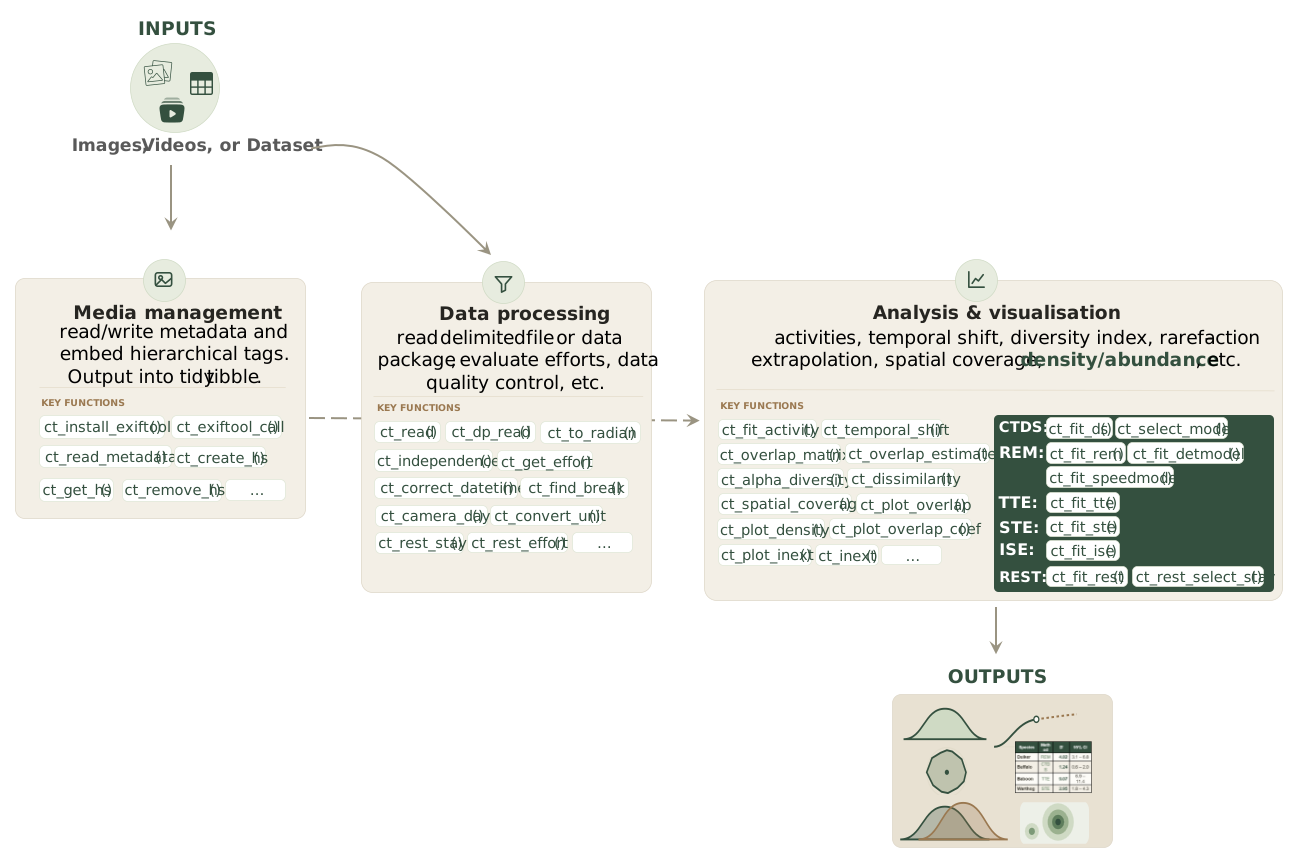
For a full overview of all available functions, please visit the ct website
Installation:
You can install ct directly from GitHub:
# Install pak firstly if not installed
if (!requireNamespace("pak", quietly = TRUE)) {
  install.packages("pak", dependencies = TRUE)
}

# Install ct from GitHub
pak::pkg_install("stangandaho/ct")

# Install ct from CRAN
pak::pkg_install("ct")
Code of conduct
Please note that this project is based on the Contributor Covenant v2.1. By participating in this project you agree to abide by its terms.
Getting help
If you encounter a clear bug, please file an issue with a minimal reproducible example. For questions and other discussion, please use relevant section.
Funding
The development of the ct package is supported by the R Consortium Infrastructure Steering Committee (ISC) under grant 25-ISC-1-04. This funding enables the creation of comprehensive statistical tools for camera trap data analysis, including population density estimation methods, and standardized data integration workflows.